
Hamburg Speech on the future of Europe
with Former Italian Prime Minister Paolo Gentiloni
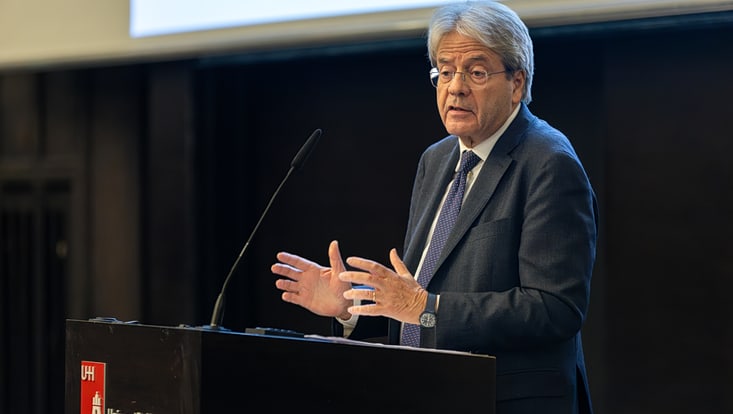
The second Hamburg Speech on the Future of Europe, held as part of the multi-year conference series of the Hamburg-Vigoni Forum, took place on Monday, February 16, 2026. More than 300 participants from academia, politics and civil society gathered to hear former Italian Prime Minister Paolo Gentiloni reflect on Europe’s future, focusing in particular on European Strategic Autonomy Four Years After Russia’s Invasion of Ukraine.
Gentiloni has shaped European politics at the highest level: as Italy’s Foreign Minister, as Prime Minister, and as European Commissioner for the Economy during some of the most turbulent years in the European Union’s recent history.
Opening his address, Gentiloni stressed that Europe finds itself in a historic moment defined by profound geopolitical shifts – particularly in relation to Russia and the United States – and that new solutions are urgently required. “There is no point looking back,” he remarked. “Nostalgia is not a strategy.” Instead, Europe must “find new solutions,” and its search for strategic autonomy is part of this broader effort. “Strategic autonomy is an urgent necessity,” he warned. “Failure to achieve it would not only endanger Europe’s future – it would jeopardize Europe’s present.”
In this perspective, strategic autonomy does not mean a refusal of alliances, but rather a refusal to be coerced into a future Europe does not want or believe in. “Strategic autonomy is first and foremost about preparedness,” Gentiloni argued. He outlined how such preparedness should take shape in the fields of security and defence, economic policy, and investment – including investments “in democracy, in institutions and in our citizens.”
Despite the gravity of current challenges, Gentiloni did not strike a pessimistic tone. His outlook for the coming years and decades is grounded in the conviction that Europe has already achieved a great deal – from supporting Ukraine to managing the economic and social consequences of the pandemic. Europe, he noted, “has accomplished a great deal without sacrificing its democratic credentials.” Yet the time has come for Europe to seize the moment. In his view, three elements are essential: “1) greater burden sharing, 2) deeper integration, and 3) faster decision-making.” Ultimately, however, these objectives can only be achieved if Europe develops a stronger awareness of its own capacity: “We are much stronger than we appear – we have to be aware of our strength and show strength more than we are accustomed to.”
Gentiloni’s speech was followed by a panel discussion featuring Luigi Mattiolo, President of Villa Vigoni – the German-Italian Centre for European Dialogue; Professor Ursula Schröder, Director of the Institute for Peace Research and Security Policy at the University of Hamburg; and Liv Assmann, State Secretary and Plenipotentiary of the Free and Hanseatic City of Hamburg to the Federation, the European Union and for Foreign Affairs. The panel explored key aspects of Gentiloni’s address, with particular attention to strategic autonomy in security and defence policy, economic governance, and EU institutional reform, as well as the role of the German-Italian partnership in advancing these objectives.
On February 15, the former European Commissioner also took part in a discussion at the Helmut and Loki Schmidt House, hosted by the Helmut and Loki Schmidt Foundation, where participants examined the European Union’s economic outlook and long-term strategic prospects.